Showing posts with label Universe. Show all posts

Wednesday, October 25, 2023

Beyond the Event Horizon: Unraveling the Mysteries of Black Holes


 Introduction:

In the vast cosmic tapestry of the universe, there exist enigmas so profound that they challenge the very fabric of our understanding. Among these cosmic wonders, none are as intriguing and perplexing as black holes. These enigmatic entities, shrouded in darkness, continue to captivate the imaginations of scientists and stargazers alike. In this blog
post, we embark on a cosmic journey to explore the fascinating world of black holes, delving into their unique characteristics and the mysteries that surround them.

1. Singularity at the Core:

At the heart of a black hole lies a singularity, a point of infinite density where the laws of physics, as we understand them, break down. The singularity is thought to be infinitely small and infinitely dense, creating a gravitational pull so strong that not even light can escape its grasp.

2. Event Horizon:

The boundary surrounding a black hole, beyond which nothing can escape, is called the event horizon. Once an object crosses this boundary, it is inevitably pulled into the black hole, making the event horizon an invisible point of no return.

3. Spaghettification:

As an object approaches a black hole, the gravitational tidal forces become significantly stronger near the event horizon. This intense gravitational pull can stretch and deform the object in a process humorously termed "spaghettification."

4. Supermassive Black Holes:

Supermassive black holes, found at the centers of galaxies, can have masses equivalent to millions or even billions of times that of our sun. The exact mechanisms behind their formation and evolution remain a topic of active research in astrophysics.

5. Wormholes:

Some theoretical models suggest that black holes might be connected by hypothetical passages called wormholes, providing shortcuts through spacetime. These wormholes are purely speculative and are yet to be observed or proven.

6. Hawking Radiation:

Proposed by physicist Stephen Hawking, Hawking radiation is a theoretical prediction suggesting that black holes can emit radiation and gradually lose mass over time. This phenomenon arises due to quantum effects near the event horizon and challenges the idea that nothing can escape a black hole.

7. Information Paradox:

The fate of information that falls into a black hole is a topic of intense debate in theoretical physics. The information paradox questions whether the information about the objects swallowed by a black hole is lost forever or somehow preserved, challenging our understanding of fundamental physics principles.

8. Black Hole Mergers:

When two black holes orbit each other and eventually merge, they create ripples in spacetime known as gravitational waves. These waves were first observed in 2015, confirming a prediction made by Albert Einstein a century earlier and opening a new era of observational astronomy.

9. Black Holes and Time Dilation:

Due to the intense gravitational field around a black hole, time passes more slowly for an observer near the event horizon compared to someone in a region of weaker gravity. This time dilation effect is a consequence of Einstein's theory of relativity.

10. Black Holes and Galaxy Formation:

Black holes are believed to play a significant role in the formation and evolution of galaxies. Their gravitational influence shapes the dynamics of galaxies, influencing the movement of stars and the distribution of cosmic matter.

Conclusion:

Black holes, these mysterious cosmic entities, continue to challenge our understanding of the universe. As astronomers and physicists delve deeper into their study, each revelation opens new doors to our knowledge of spacetime, gravity, and the very nature of reality. With every discovery, we step closer to unraveling the profound mysteries that black holes hold, reminding us of the boundless wonders that the universe has yet to reveal. In the darkness of a black hole's singularity, we find not just mystery, but an infinite realm of scientific exploration and awe-inspiring curiosity.

Wednesday, May 13, 2020

VOYGAR-I & VOYAGAR-II, Interstellar space - Most Distant Spacecraft

The twin Voyager 1 and 2 spacecraft are exploring where nothing from Earth has flown before. Continuing on their more-than-40-year journey since their 1977 launches, they each are much farther away from Earth and the sun than Pluto. In August 2012, Voyager 1 made the historic entry into interstellar space, the region between stars, filled with material ejected by the death of nearby stars millions of years ago. Voyager 2 entered interstellar space on November 5, 2018 and scientists hope to learn more about this interstellar region. 


The mission objective of the Voyager Interstellar Mission (VIM) is to extend the NASA exploration of the solar system beyond the neighborhood of the outer planets to the outer limits of the Sun's sphere of influence, and possibly beyond. This extended mission is continuing to characterize the outer solar system environment and search for the heliopause boundary, the outer limits of the Sun's magnetic field and outward flow of the solar wind. Penetration of the heliopause boundary between the solar wind and the interstellar medium will allow measurements to be made of the interstellar fields, particles and waves unaffected by the solar wind.

The Golden Record
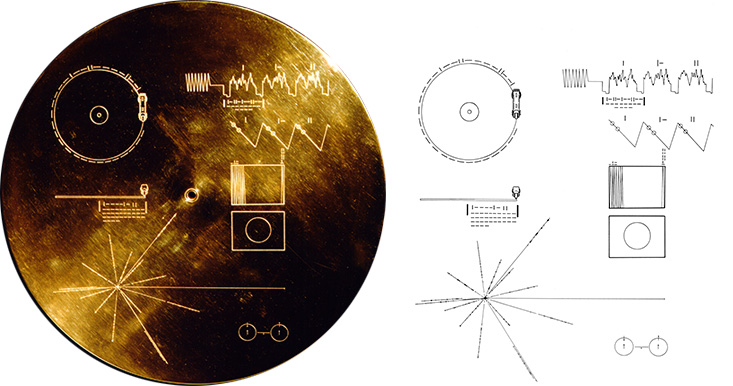
Both Voyager spacecrafts carry a greeting to any form of life, should that be encountered. The message is carried by a phonograph record - -a 12-inch gold-plated copper disk containing sounds and images selected to portray the diversity of life and culture on Earth. The contents of the record were selected for NASA by a committee chaired by Carl Sagan of Cornell University. Dr. Sagan and his associates assembled 115 images and a variety of natural sounds. To this they added musical selections from different cultures and eras, and spoken greetings from Earth-people in fifty-five languages.
Golden Record


Saturday, May 9, 2020

Earth Atmosphere Layers & Properties of each Layer

Earth's atmosphere has a series of layers, each with its own specific traits. Moving upward from ground level, these layers are named the troposphere, stratosphere, mesosphere, thermosphere and exosphere. The exosphere gradually fades away into the realm of interplanetary space.


Troposphere
The troposphere is the lowest layer of our atmosphere. Starting at ground level, it extends upward to about 10 km (6.2 miles or about 33,000 feet) above sea level. 
  • We humans live in the troposphere, and nearly all weather occurs in this lowest layer. 
  • Most clouds appear here, mainly because 99% of the water vapor in the atmosphere is found in the troposphere. 
  • Air pressure drops, and temperatures get colder, as you climb higher in the troposphere.


Stratosphere
The stratosphere extends from the top of the troposphere to about 50 km (31 miles) above the ground. 
  • The infamous ozone layer is found within the stratosphere. Ozone molecules in this layer absorb high-energy ultraviolet (UV) light from the Sun, converting the UV energy into heat.
  • Unlike the troposphere, the stratosphere actually gets warmer the higher you go! That trend of rising temperatures with altitude means that air in the stratosphere lacks the turbulence and updrafts of the troposphere beneath. 
  • Commercial passenger jets fly in the lower stratosphere, partly because this less-turbulent layer provides a smoother ride. The jet stream flows near the border between the troposphere and the stratosphere.

Mesosphere
Above the stratosphere is the mesosphere. It extends upward to a height of about 85 km (53 miles) above our planet. 
  • Most meteors burn up in the mesosphere. Unlike the stratosphere, temperatures once again grow colder as you rise up through the mesosphere. 
  • The coldest temperatures in Earth's atmosphere, about -90° C (-130° F), are found near the top of this layer. 
  • The air in the mesosphere is far too thin to breathe; air pressure at the bottom of the layer is well below 1% of the pressure at sea level, and continues dropping as you go higher.

Thermosphere
The layer of very rare air above the mesosphere is called the thermosphere. 
  • High-energy X-rays and UV radiation from the Sun are absorbed in the thermosphere, raising its temperature to hundreds or at times thousands of degrees. However, the air in this layer is so thin that it would feel freezing cold to us! In many ways, the thermosphere is more like outer space than a part of the atmosphere. 
  • Many satellites actually orbit Earth within the thermosphere! 
  • Variations in the amount of energy coming from the Sun exert a powerful influence on both the height of the top of this layer and the temperature within it. Because of this, the top of the thermosphere can be found anywhere between 500 and 1,000 km (311 to 621 miles) above the ground. Temperatures in the upper thermosphere can range from about 500° C (932° F) to 2,000° C (3,632° F) or higher. 
  • The aurora, the Northern Lights and Southern Lights, occur in the thermosphere.

Ionosphere
The ionosphere is not a distinct layer like the others mentioned above. Instead, the ionosphere is a series of regions in parts of the mesosphere and thermosphere where high-energy radiation from the Sun has knocked electrons loose from their parent atoms and molecules. The electrically charged atoms and molecules that are formed in this way are called ions, giving the ionosphere its name and endowing this region with some special properties.

Exosphere
Although some experts consider the thermosphere to be the uppermost layer of our atmosphere, others consider the exosphere to be the actual "final frontier" of Earth's gaseous envelope. 
  • As you might imagine, the "air" in the exosphere is very, very, very thin, making this layer even more space-like than the thermosphere. In fact, air in the exosphere is constantly - though very gradually - "leaking" out of Earth's atmosphere into outer space. 
  • There is no clear-cut upper boundary where the exosphere finally fades away into space. Different definitions place the top of the exosphere somewhere between 100,000 km (62,000 miles) and 190,000 km (120,000 miles) above the surface of Earth. The latter value is about halfway to the Moon!

Tuesday, January 6, 2015

25 Pictures that will make you completely re-evaluate your existence

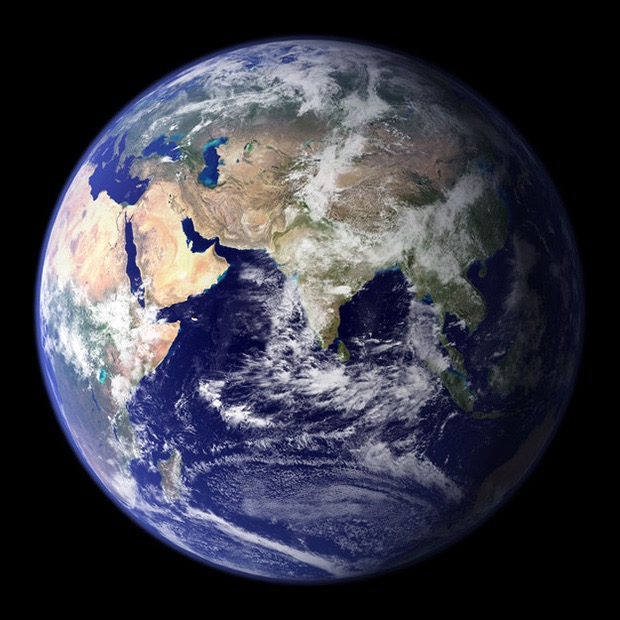
1. This is where we all live, our Earth.

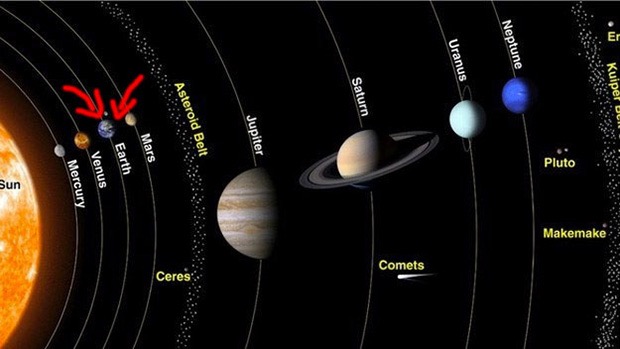
2. This the solar system, our “neighborhood”.

via: foxnews.com

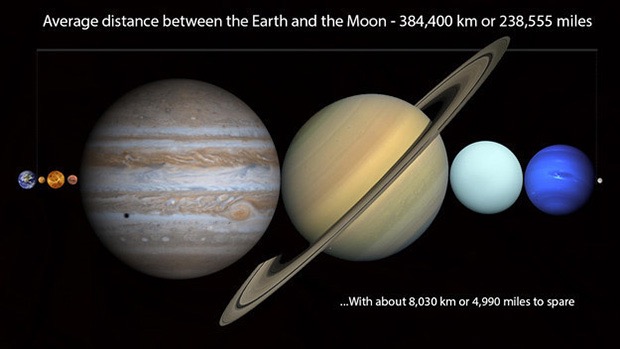
3. This is the scaled distance between Earth and Moon. You thought the moon was farther?

we-are-tiny-24

4. What if I told you that between Earth and moon you could fit every planet of our solar system?

via: reddit.com
via: reddit.com

5. If you still don’t have a measure of how tiny we are, here is North America compared to Jupiter.

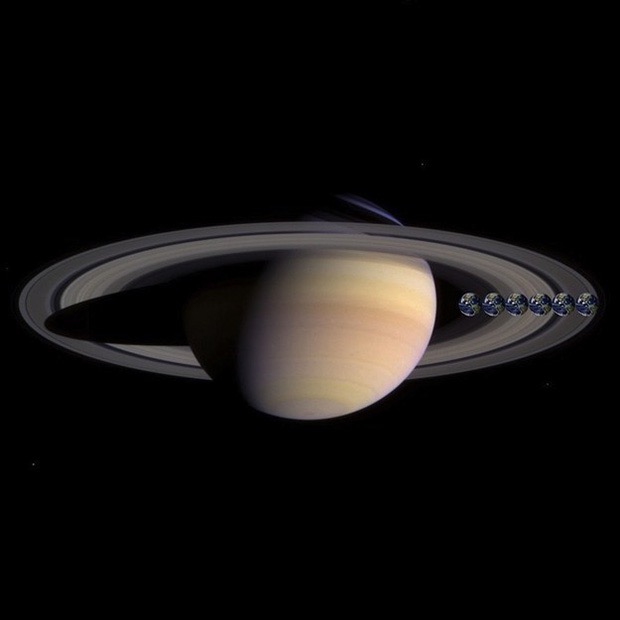
6. You could line up SIX Earths on the Saturn’s rings.

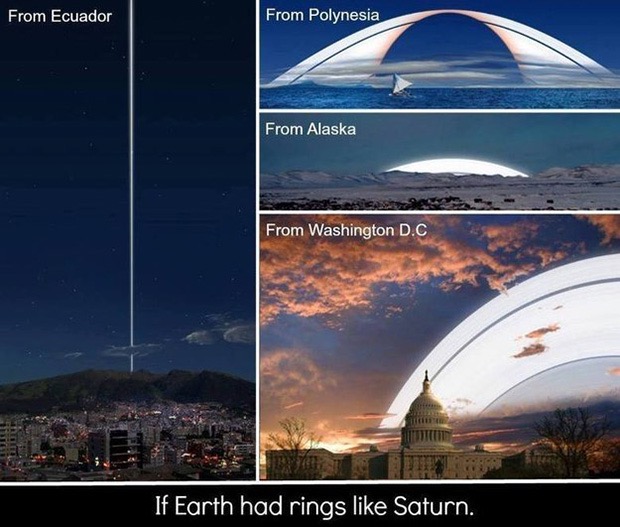
7. And here is how our sky would look like if Earth had rings like Saturn.

via: io9.com
via: io9.com

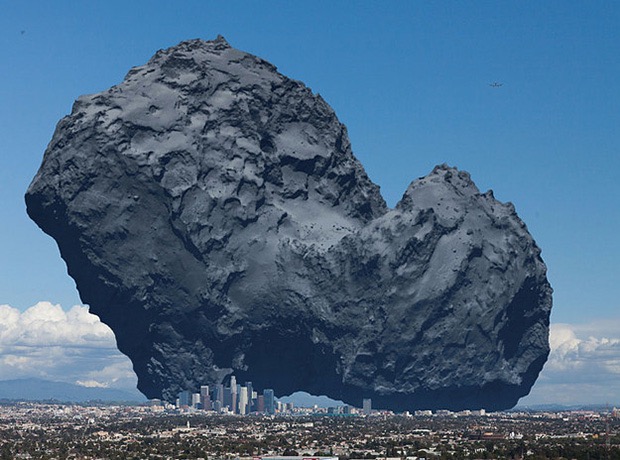
8. This is a comet, compared to Los Angeles. Big, isn’t it?

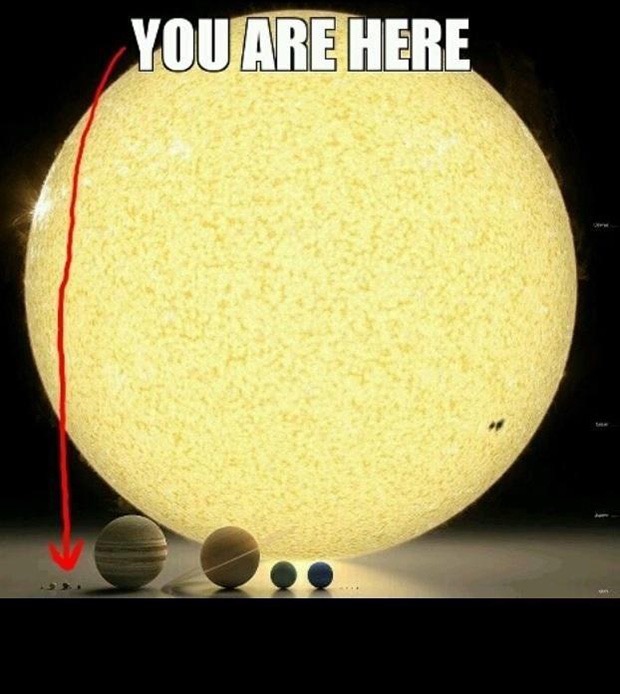
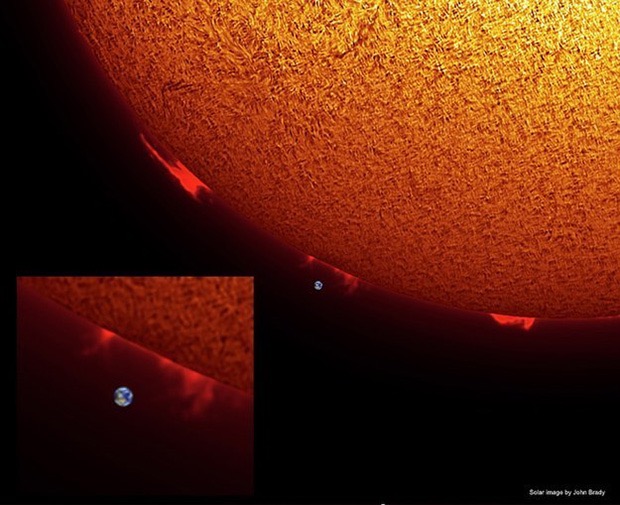
9. If that was big, here is the sun, and we are that tiny little point down there.

via: twitter.com

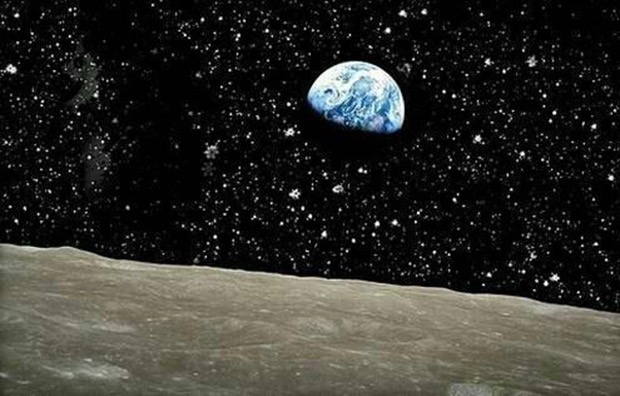
10. And here is how we look like from the moon.

NASA
NASA

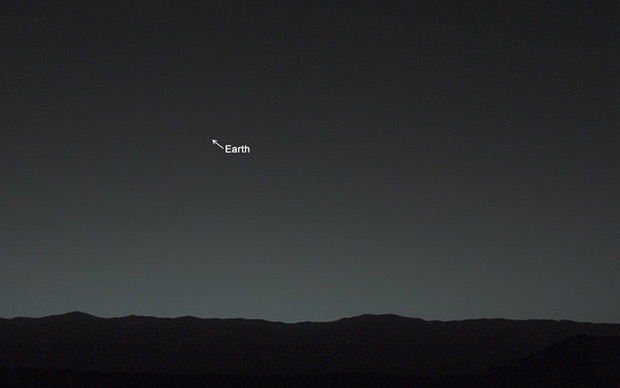
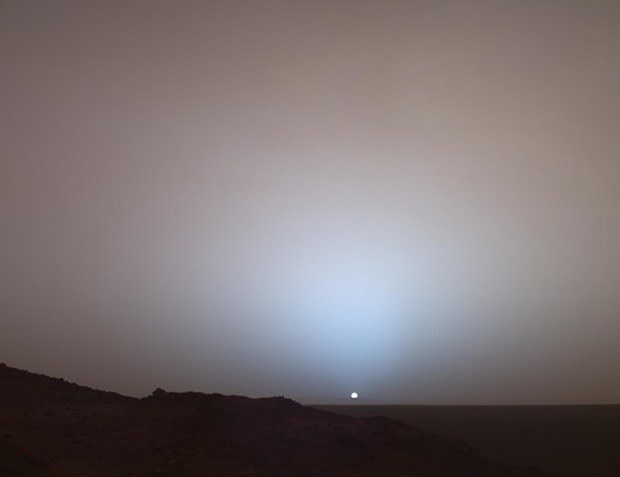
11. And from Mars.

NASA
NASA

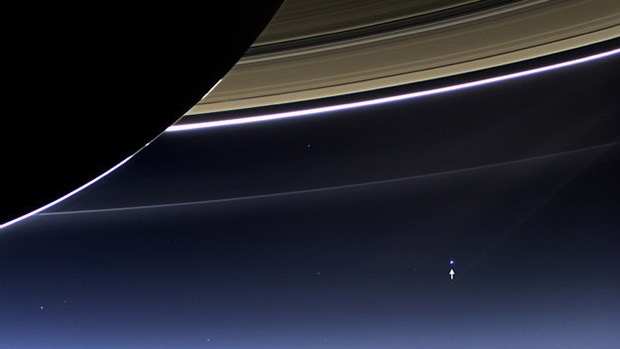
12. From Saturn.

NASA
NASA

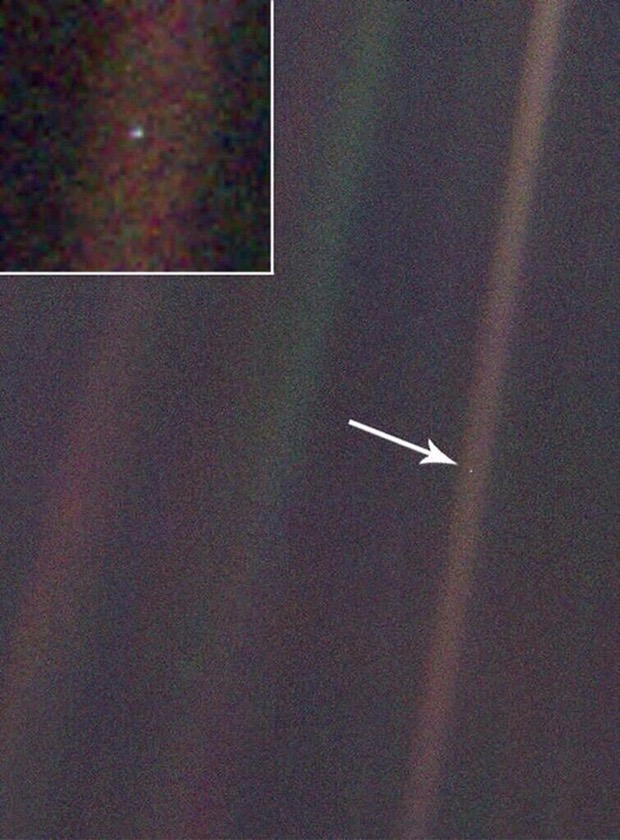
13. And from Neptune, 4 billion miles away.

NASA
NASA

14. But let’s look again at how we look like compared to the sun. It blows my mind every time.

15. That little dot is the sun, seen from Mars.

NASA
NASA

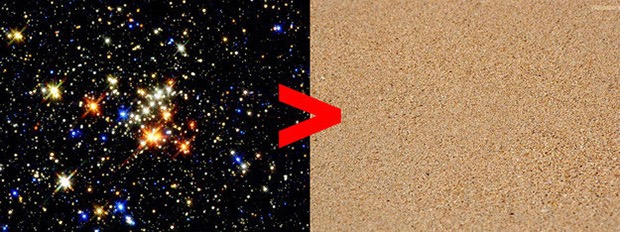
16. Did you know that there are more stars in space than there are grains of sand on every beach on Earth?

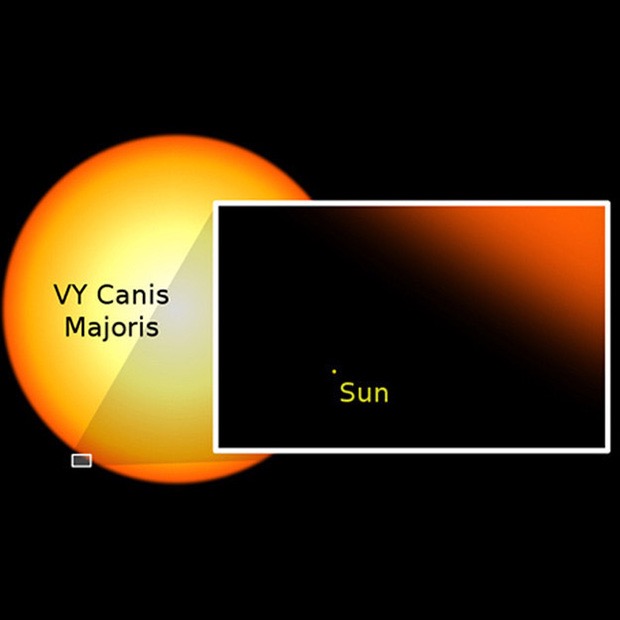
17. And between all these stars, many are much bigger than our sun. Take a look at how it looks compared to VY Canis Majoris.

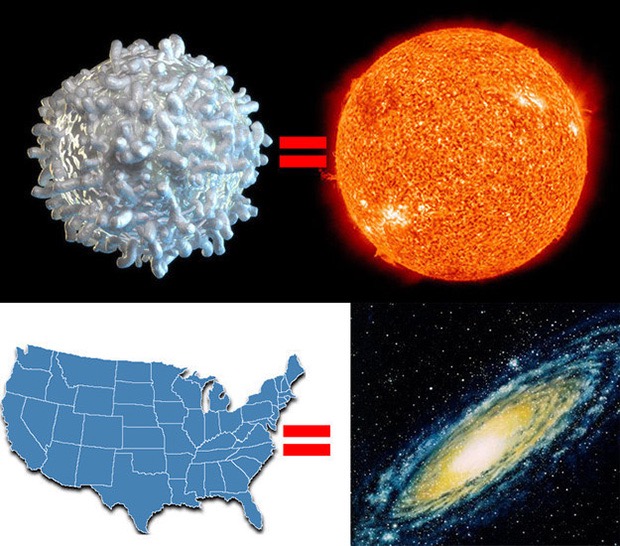
18. And galaxies are incredibly bigger. Just so you understand: if the sun was a blood cell, the Milky Way would be as big as the United States!

via: reddit.com
via: reddit.com

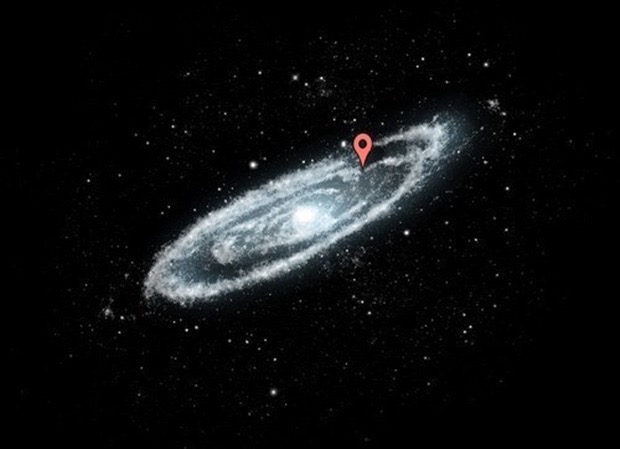
19. The Milky Way is enormous. Here is where we are inside it.

via: teecraze.com

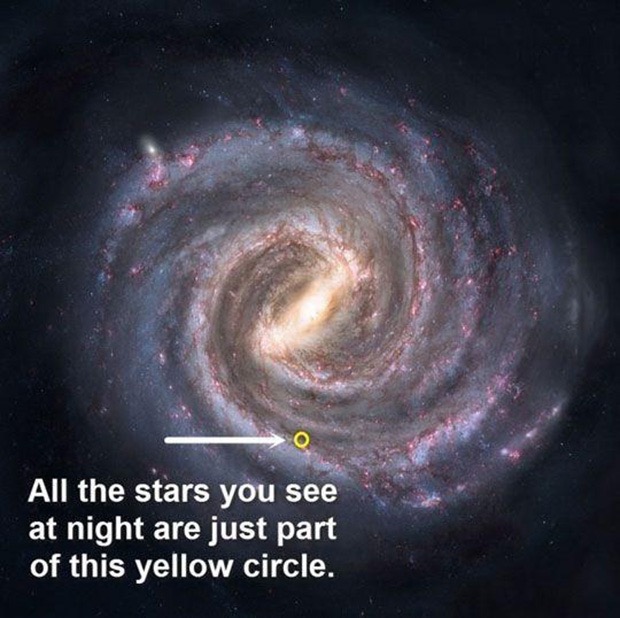
20. It’s mind blowing to think that all the stars we can see to the naked eye at night are just part of this yellow circle.

via: twitter.com

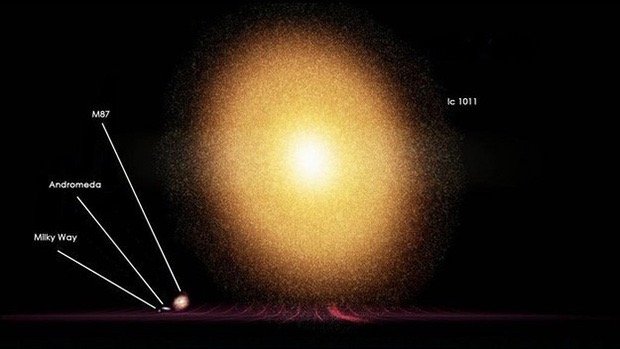
21. But don’t you ever think the Milky Way is the biggest galaxy in space. Here it is compared to Ic 1011!

via: twitter.com

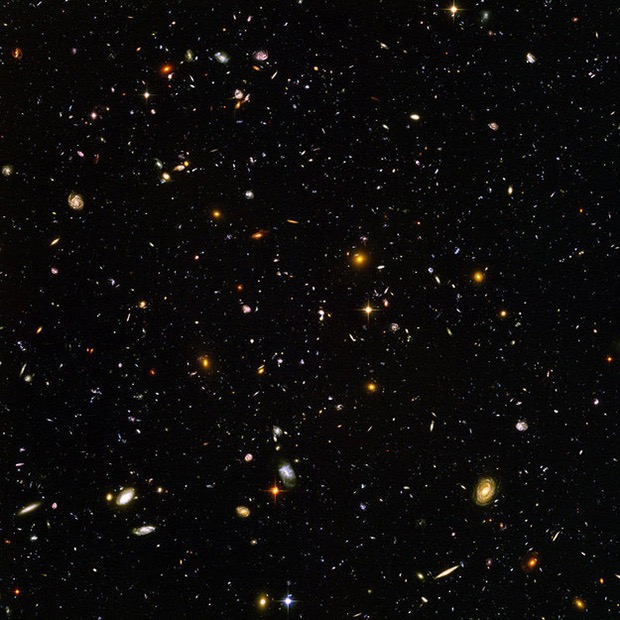
22. This is a picture taken from the Hubble telescope. In just this space there are millions of galaxies, each and everyone of them containing million of stars, each with planets orbiting around them.

23. This is one of these galaxies. It’s named UDF 423, and it’s 10 billion light years away. Do you know what this means? It means that it’s light takes 10 billion years to reach the Earth. Basically, by looking at this galaxy you are looking 10 billion years into the past!

via: wikisky.org

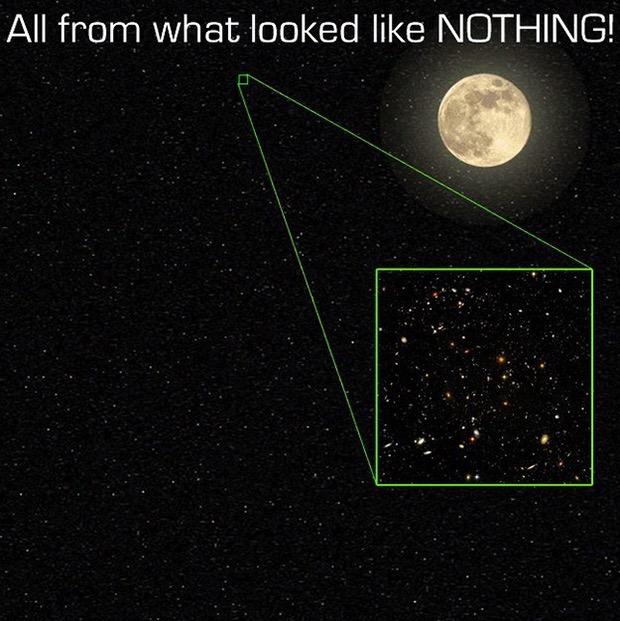
24. Keep in mind that every single inch of your vision of the night sky contains billions of galaxies, stars, planets.

via: thetoc.gr
via: thetoc.gr

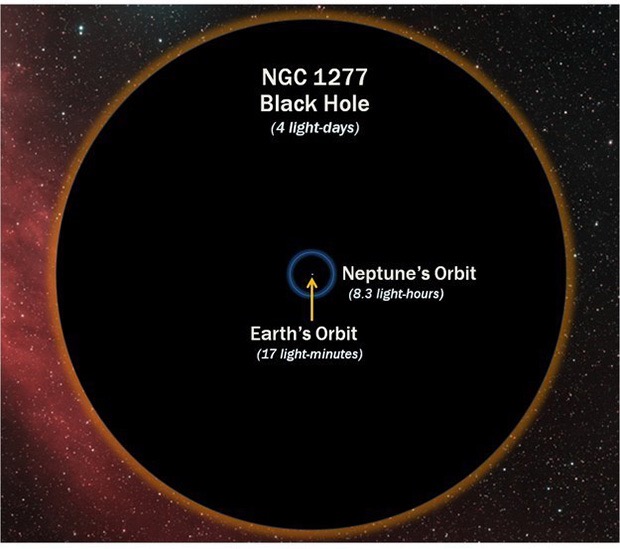
25. But it’s not all roses out there. Here is a black hole compared to our orbit. A black hole is a region of spacetime where gravity is so strong that no particle or light ray entering that region can ever escape from it.

So whenever you think about your life and existence, about the good and bad in this world, keep in mind that we are just a tiny, little dot lost in space. Just a little recap. This is where we live.

photo credits: Andrew Z. Colvin  (Own work) [CC-BY-SA-3.0], via Wikimedia Commons
photo credits: Andrew Z. Colvin (Own work) [CC-BY-SA-3.0], via Wikimedia Commons

This is how we look like in our solar system.

photo credits: Andrew Z. Colvin  (Own work) [CC-BY-SA-3.0], via Wikimedia Commons
photo credits: Andrew Z. Colvin (Own work) [CC-BY-SA-3.0], via Wikimedia Commons

And in our interstellar neighborhood.

photo credits: Andrew Z. Colvin  (Own work) [CC-BY-SA-3.0], via Wikimedia Commons
photo credits: Andrew Z. Colvin (Own work) [CC-BY-SA-3.0], via Wikimedia Commons

Our neighborhood compared to our galaxy.

photo credits: Andrew Z. Colvin  (Own work) [CC-BY-SA-3.0], via Wikimedia Commons
photo credits: Andrew Z. Colvin (Own work) [CC-BY-SA-3.0], via Wikimedia Commons

And how it looks like from farther.

photo credits: Andrew Z. Colvin  (Own work) [CC-BY-SA-3.0], via Wikimedia Commons
photo credits: Andrew Z. Colvin (Own work) [CC-BY-SA-3.0], via Wikimedia Commons

Let’s zoom out a little more.

photo credits: Andrew Z. Colvin  (Own work) [CC-BY-SA-3.0], via Wikimedia Commons
photo credits: Andrew Z. Colvin (Own work) [CC-BY-SA-3.0], via Wikimedia Commons

Some more.

photo credits: Andrew Z. Colvin  (Own work) [CC-BY-SA-3.0], via Wikimedia Commons
photo credits: Andrew Z. Colvin (Own work) [CC-BY-SA-3.0], via Wikimedia Commons

And here we are, here is the observable universe. Everything we said before fits in that little red dot. Impressive, right?

photo credits: Andrew Z. Colvin  (Own work) [CC-BY-SA-3.0], via Wikimedia Commons
photo credits: Andrew Z. Colvin (Own work) [CC-BY-SA-3.0], via Wikimedia Commons

Thinking about how tiny and insignificant we are compared to the universe totally blew my mind

Related Posts with Thumbnails