Tuesday, March 23, 2010

Petronas Tower

The Petronas Twin Towers (also known as the Petronas Towers or just Twin Towers), in Kuala Lumpur, Malaysia were the world's tallest buildings from 1998 to 2004, when their height was surpassed by Taipei 101. The towers remain the tallest twin buildings in the world.

Height: 1,483 ft (452 meters)
Owners: Kuala Lumpur City Centre Holdings Sendirian Berhad

Architects: Cesar Pelli & Associates
Engineers: Thornton-Tomasetti Engineers
Contractors: Mayjus and SKJ Joint Ventures
Topping Out: 1998


Official Opening: August 28, 1999 

History of Construction:

 Petronas, Malaysia's national oil company, set out to build the world's tallest building. Although other buildings such as the Sears Tower have higher occupied floors, a higher pinnacle, and a higher roof, the Petronas Towers' spires are classified as architectural details and rise to 452 m (1483 feet)--the highest feature classified as an architectural detail on a high rise until Taipei 101.
The towers were designed by architect César Pelli, were completed in 1998. The 88-floor towers constructed of largely reinforced concrete with a steel and glass facade were designed to resemble motifs found in Islamic art, a reflection of Malaysia's Muslim heritage. They were built on the site of Kuala Lumpur's race track. Because of the depth of the bedrock the buildings were built on the world's deepest foundation going down some 120 meters and requiring massive amounts of concrete. In an unusual move, a different construction company was hired for each of the towers, and they were made to compete against each other. 

Eventually the builders of Tower 2, Samsung, won the race, despite starting a month behind Tower 1, built by Hazama Corporation, although Tower 2 ran into problems when they discovered the structure was 25 millimeters off from vertical. Due to a lack of steel and the huge cost of importing steel, the towers were constructed on a cheaper radical design of super high strength reinforced concrete. High-strength concrete is a material familiar to Asian contractors and twice as effective as steel in sway reduction. Supported by 23-by-23-metre concrete cores and an outer ring of widely-spaced super columns, the towers showcase a sophisticated structural system that accommodates its slender profile and provides from 1300 to 2000 square metres of column-free office space per floor.

Monday, March 8, 2010

Cannibalism - Eating of Human by Another Human

Cannibalism  a West Indies tribe well known for their practice of cannibalism), also called anthropophagy, is the act or practice of humans eating the flesh of other human beings.Cannibalism has recently been both practiced and fiercely condemned in several wars, especially in Liberia and Congo. Today, the Korowai are one of very few tribes still believed to eat human flesh. It is also still known to be practiced as a ritual and in war in various Melanesian tribes.

Reasons for cannibalism

The reasons for cannibalism include the following:
  • As sanctioned by a cultural norm
  • By necessity in extreme situations of famine
  • Caused by insanity or social deviancy
There are fundamentally two kinds of cannibalistic social behavior; endocannibalism (eating humans from the same community) and exocannibalism (eating humans from other communities).
A separate ethical distinction can be made to delineate between the practice of killing a human for food (homicidal cannibalism) versus eating the flesh of a person who was already dead (necro-cannibalism).

There are many forms of spiritual and ritualistic cannibalism worldwide. 
Exocannibalism:
Exocannibalism is defined as a culture, group or tribe's consumption of another culture, group or tribe. This form of cannibalism has been associated with tribal power, murder and aggression and has been used in an effort to scare off possible invading enemies, to get rid of captured enemies of war and slaves. Many cannibalistic tribes believed that consuming one's enemy would allow them to obtain and absorb the spirit and skills of the victim. 

Endocannibalism:
Conversely, the consumption of members within one's own culture, group or tribe is called Endocannibalism, which is often associated with ritual burial ceremonies and has been controversially referred to on occasion as "compassionate cannibalism." Mortuary cannibalism has been considered to be the most widely practiced form of endocannibalism, often excluding murder and focusing on already deceased corpses.


The ancient Aztecs in Mexico were believed to have sacrificed and cannibalized thousands of humans on an annual basis. The Aztecs were believed to have practiced exocannibalism, as well as endocannibalism and survival cannibalism. Human sacrifice and cannibalism was practiced in an effort to create a universal balance between of the world and the cosmos.

Other cultures participated in endo- and exo-cannibalism for similar reasons, such as The North American Indians, known as the Iroquoian. They believed that sacrificing and consuming the bodies of their enemies would satisfy their war god and lead to their spirit being transferred and absorbed into their own bodies. The absorbed spirit was believed to empower the cannibal with the attributes of the dead person. Moira Martingale, author of Cannibal Killers, claims that this form of ritualistic cannibalism was practice by the Iroquoian culture as recently as 1838.

Monday, November 23, 2009

2012 Mayan Calender

Do you think the world will culminate soon? Well, this is the prediction that the Mayan calendar tells about the future. So what is the 2012 Mayan Calendar all about? It is actually made up of two different calendars namely Tzolk'in and Haab. You will find 260 days in the Tzolk'in calendar and 365 days in the Haab calendar. Both these calendars combined together will make a big cycle of fifty two years, called as a Calendar Round.


What is the effect of Mayan Calendar on you?
When you study about the 2012 Mayan Calendar, you will get to know about numerous predictions about the future. Information available in the calendar are always accurate, be it time for sunrises or sunsets. Mayans are extremely skilled in creating a lot of calendars. If you make a detailed study about the Mayan Calendars, you will find a prediction saying that the world will culminate on December 21, 2012. But this prediction is becoming a matter of question for many people. So in this post I will be trying to tell about Maya Culture and Maya Calender and will also discuss illusion regarding Maya Calender.

Maya Culture
The Mayan culture has undergone substantial changes throughout its existence. It is part of the wider context of Mesoamerican civilization that stretched from Central America into the present-day southern United States. This civilization was based on the cultivation of maize and shared the sacred 260-day calendar. It is estimated that the Maya started to cultivate maize about 5000 years ago, around the time set for the beginning of their Long Count. It is however only about the time of Christ that we can talk about the emergence of a high culture among the Maya.

The Mayan Calender

The Mayan calendar is associated with nine creation cycles, which represent nine levels of consciousness or Underworlds as symbolized by the Mayan pyramids. This pyramidal structure of consciousness development can explain things as disparate as the common origin of world religions and the modern complaint that time seems to be moving faster.
Time, in fact, is speeding up as we transition from the materialist Planetary Underworld that still governs us to a new and higher frequency of consciousness, the Galactic Underworld, in preparation for the final Universal level of conscious Enlightenment.
The Mayan calendar is thus a spiritual device that enables a greater understanding of the evolution of consciousness driving human history and the concrete steps we can take to align ourselves with this cosmic evolution toward Enlightenment.


The Mayan Use of the Calendar


In addition to its role as a contact to the ancestors, the Maya used the calendar for celebrating significant energy shifts. At these times the shaman kings would make prophecies about the time ahead in the new energy. A base of knowledge had been created as to how the energies would shift according to the calendar, and, in combination with the shamanic connection to the World Tree, prophecies of relevance to the present moment and the immediate time ahead were developed. 
The aspect of the Mayan calendar system that has survived to the present time is the uninterrupted use of the Sacred Calendar of 260 days. Mayan day-keepers daily pray to the Creator and perform ceremonies that honor the day signs. Among the living Maya the 260-day calendar has various roles:

  1. To keep track of the energies of the day,
  2. To calculate birth energies of different individuals,
  3. To determine the celebration of holidays,
  4. To base healing practices on,
  5. For prophecy, and
  6. For divination of individual destinies.

The Mayan Calendar End date

Many people hear about the so-called end date of the Mayan calendar, and today some people have even created the illusion that the Mayan calendar was designed only to point out this end date. In reality, there is nothing to indicate that the ancient Maya who developed the Long Count calendar had any interest in what would happen as this calendar came to an end. Instead what the ancient Mayan scriptures talk about is its beginning. The exact date for this beginning was apparently based on the day of the year, August 11, when the sun was in zenith in Izapa, where most likely this calendar first came into use. Ancient Mayan inscriptions also talk about this time as the time when the First Father erected the World Tree so that the light could enter, a significant event in creation. The various dynasties in the different Mayan city-states would then try to track a relationship to this seminal event by First Father and legitimize their power based on this.

The fact that the Mayan Long Count was based on the day the sun was in zenith in Izapa, has however created a very significant misunderstanding among modern people, and this is that it would end on December 21, 2012. The particular date the sun is in zenith in this location obviously has no relevance in the rest of the world, but because of the power of tradition some will still adhere to it. In reality, the creation cycle that began as the First Father erected the World Tree will end on October 28, 2011. This day is also 13 Ahau in the sacred Mayan calendar, an energy with great prophetical relevance.


Tuesday, November 10, 2009

Amazing Facts About India - BHARAT


The official Sanskrit name for India is Bharat. INDIA has been called Bharat even in Satya yuga ( Golden Age ) More interesting facts about India
  • The name `India’ is derived from the River Indus, the valleys around which were the home of the early settlers. 
  •  The Persian invaders converted it into Hindu. The name `Hindustan’ combines Sindhu and Hindu and thus refers to the land of the Hindus.
  • The number system was invented by India. Aryabhatta was the scientist who invented the digit zero.
  • Sanskrit is considered as the mother of all higher languages. This is because it is the most precise, and therefore suitable language for computer software. 
  • Chess was invented in India.
  • Algebra, Trigonometry and Calculus are studies which originated in India.
  • The' place value system' and the 'decimal system' were developed in 100 BC in India.
  • The first six Mogul Emperor's of India ruled in an unbroken succession from father to son for two hundred years, from 1526 to 1707.
  • The World's First Granite Temple is the Brihadeswara temple at Tanjavur in Tamil Nadu. The shikhara is made from a single ' 80-tonne ' piece of granite. Also, this magnificient temple was built in just five years, (between 1004 AD and 1009 AD)  during the reign of Rajaraja Chola
  • India is the Largest democracy in the world, the 6th largest country in the world and one of the most ancient and living civilizations (at least 10, 000 years old). 
  • The game of snakes & ladders was created by the 13th century poet saint Gyandev. It was originally called  'Mokshapat.' The ladders in the game represented virtues and the snakes indicated vices. The game was played with cowrie shells and dices. Later through time,  the game underwent several modifications but the meaning is the same i.e good deeds take us to heaven and evil to a cycle of re-births.
  • The world's highest cricket ground is in Chail, Himachal Pradesh. Built in 1893 after levelling a hilltop, this cricket pitch is 2444 meters above sea level.
  • The World's first university was established in Takshila in 700 BC. More than 10,500 students from all over the world studied more than 60 subjects. The University of Nalanda built in the 4th century was one of the greatest achievements of ancient India in the field of education.
  • Ayurveda is the earliest school of medicine known to mankind. The father of medicine, Charaka, consolidated Ayurveda 2500 years ago.

  • Although modern images & descriptions of India often show poverty, India was one of the richest countries till the time of British in the early 17th Century. 
  • The art of Navigation & Navigating was born in the river Sindh 6000 over years ago. The very word 'Navigation' is derived from the Sanskrit word NAVGATIH. The word navy is also derived from the Sanskrit word 'Nou'.
  • Bhaskaracharya rightly calculated the time taken by the earth to orbit the sun hundreds of years before the astronomer Smart. His calculations was - Time taken by earth to orbit the sun: ( 5th century ) 365.258756484 days.
  • The value of "pi" was first calculated by the Indian Mathematician Budhayana, and he explained the concept of what is known as the Pythagorean Theorem. He discovered this in the 6th century, which was long before the European mathematicians.
  • Algebra, trigonometry and calculus also orignated from India.  Quadratic equations were used by Sridharacharya in the 11th century. The largest numbers the Greeks and the Romans used were 106 whereas Hindus used numbers as big as 10*53 ( i.e 10 to the power of 53 ) with specific names as early as 5000 B.C.  during the Vedic period.  Even today, the largest used number is Tera: 10*12( 10 to the power of 12 ).
  •  Until 1896, India was the only source for diamonds to the world. ( Source . Gemological Institute of America )
  • The Baily Bridge is the highest bridge in the world. It is located in the Ladakh valley between the Dras and Suru rivers in the Himalayan mountains. It was built by the Indian Army in August 1982.
  • Usage of anesthesia was well known in ancient India medicine. Detailed knowledge of anatomy, embryology, digestion, metabolism,  physiology, etiology, genetics and immunity is also found in many ancient Indian texts.


Facts to make every Indian proud


Q. Who is the co-founder of Sun Microsystems?
A. Vinod Khosla


Q. Who is the creator of Pentium chip (needs no introduction as 90% of the today's computers run on it)?
A. Vinod Dahm


Q. Who is the founder and creator of Hotmail (Hotmail is world's No.1 web based email program)?
A. Sabeer Bhatia


Q. Who is the president of AT & T-Bell Labs (AT & T-Bell Labs is the creator of program languages such as C, C++, Unix to name a few)?
A. Arun Netravalli


Q. Who is the GM of Hewlett Packard?
A. Rajiv Gupta


Q. Who is the new MTD (Microsoft Testing Director) of Windows 2000, responsible to iron out all initial problems?
A. Sanjay Tejwrika


Q. Who are the Chief Executives of CitiBank, Mckensey & Stanchart?
A. Victor Menezes, Rajat Gupta, and Rana Talwar.


Q. Who is the co-founder of USB?
A.Ajay Batt.

Wednesday, November 4, 2009

SAHARA - World's Biggest Desert


The Sahara, with a size of 8.6 million km²(3,500,000 sq mi), is the world's largest desert. It covers most of Northern Africa, making it almost as large as the United States or the continent of Europe. Around 4 million people live here. Its maximum length is 4,800 km, running from west to east, and up to 1,200 km from north to south. Sahara covers most of Mauritania, Western Sahara, Algeria, Libya, Egypt, Sudan, Chad, Niger and Mali, and touches Morocco and Tunisia.To the north, Sahara is bordered by the Atlas Mountains and the Mediterranean Sea; in the west by the Atlantic Ocean; in the south, the desert zone reaches 16º northern latitude; in the east it is bordered by the Nile. Still the desert continues to the east of the river until it reaches the Red Sea, but this is not considered a part of the Sahara.

Sand sheets and dunes represent about 25% of the Sahara; the other parts are mountains, stoney steppes and oases. Pyramidal dunes can be as high as 150 metres, while mountainous sand ridges as high as 350 metres.
There are several rivers running through the Sahara, of which the Nile River and Niger River are the only permanent ones. The rest being seasonal, involves that most of the time, there is only a dry river bed, which may carry water for brief periods following uncommon rainfalls. There may be years in between this happening.

Amazing Facts Of Sahara Desert:
  • World's largest Hot desert covering around 9,00,000 square km.
  • Although being a desert area, one can notice annual rainfall in many regions of this vast land area. There are different climates witnessed in different regions.
  • This hot desert has annual temperatures. Some of the hottest months have temperatures exceeding 50 degrees C. In the winters, the temperatures drop below freezing points. This itself explains the diverse climates of this hot desert.
  • Observations made with the help of satellite photographs have proven this desert can shrink or even grow in size. 
  • This desert has some of the tallest sand dunes and these can reach 189 meters in height. The land area also has stone plateaus, large gravel plains, dry valleys and even sand flats. 
  • The Sahara desert has around 500 species of flora.
  • Emi Koussi is the highest peak that is seen in the Tibesti Mountains. This peak has a height of 3415 m.
  • This mysterious and vast place also has some of the most magnificent landscapes and despite harsh weather, it has attracted people to study details associated with the Sahara desert. This desert is more than a hot and dry place, it is one of the most remarkable areas known to man!

Climate History of Sahara: How it was formed

The climate of the Sahara has undergone enormous variation between wet and dry over the last few hundred thousand years. During the last glacial period, the Sahara was even bigger than it is today, extending south beyond its current boundaries. The end of the glacial period brought more rain to the Sahara, from about 8000 BC to 6000 BC, perhaps due to low pressure areas over the collapsing ice sheets to the north.


Once the ice sheets were gone, northern Sahara dried out. But in southern Sahara, the drying trend was soon counteracted by the monsoon, which brought rain further north than it does today. The monsoon is due to heating of air over the land during summer. The hot air rises and pulls in cool, wet air from the ocean, which causes rain. Thus, though it seems counterintuitive, the Sahara was wetter when it received more solar insulation in the summer. This was caused by a stronger tilt in Earth's axis of orbit than today, and perihelion occurred at the end of July.
By around 3400 BC, the monsoon retreated south to approximately where it is today, leading to the gradual desertification of the Sahara. The Sahara is now as dry as it was about 13,000 years ago. These conditions are responsible for what has been called the Sahara pump theory. Half of the Sahara receives less than 2 centimetres (0.79 in) of rain per year, and the rest receives up to 10 cm (3.9 in) per year.

Tuesday, November 3, 2009

10 Amazing Species - About to Disappear!!

1.Slender Loris
The slender loris, Loris tardigradus is classified as Endangered (EN A2cd+4cd) on the IUCN Red List 2004. The grey slender loris, Loris lydekkerianus is classified as Near Threatened (NT) on the IUCN Red List 2004. Two subspecies of slender loris, Loris tardigradus exist. 


The most distinguishing characteristics of the slender lorises are their very long, slender arms and legs, which give these species their names. They usually have a grey or reddish coat, although this varies according to subspecies, and the fur is soft, thick and woolly. Slender lorises do not have tails and move on all fours climbing or walking along branches. They do not have truly opposable thumbs and are only able to grasp things like food or branches with the whole hand, though they do have an extremely powerful grip. The eyes are large and round and the prominent ears are thin, rounded and naked at the edges. There is much confusion over slender loris classification.
 2. Yangtze River Dolphin -Baiji

It is/was a freshwater dolphin found only in the Yangtze Riverin China. Nicknamed "Goddess of the Yangtze" in China, the dolphin was also called Chinese River Dolphin, Yangtze River Dolphin, Whitefin Dolphin and Yangtze Dolphin. 
According to Chinese legend, this graceful freshwater dolphin is the reincarnation of a drowned princessThe 2007 IUCN Red List classifies the Baiji as extinct. The Baiji population declined drastically in recent decades as China industrialized and made heavy use of the river for fishing, transportation, and hydroelectricity. 
The baiji is a graceful freshwater dolphin, characterised by a very long, slightly upturned beak and low triangular dorsal fin. Like other river dolphins, it has little need for vision in the muddy waters it inhabits, and as a result has tiny, barely functional eyes. It is pale blue-grey in colour with a white underside. The female is generally larger than the male.


3. Attenborough's long-beaked echidna
Recently classified as three separate species, long-beaked echidnas belong to an ancient clade of egg-laying mammals that includes the platypus of Australia. They are easily distinguished from short-beaked echidnas by their long snouts, which account for two-thirds of the length of the head. Despite laws designed to protect these species, they are in decline in areas accessible to humans. Echidnas have lost much of their forest habitat to logging, mining and farming, and are regarded as highly prized game animals by local people. Size: Head and body length: 450-775 mm and Weight: 5-10 kg.
The most distinguishing feature of long-beaked echidnas is their long snouts, which curve downwards and account for two-thirds of the length of the head. They have no teeth; instead their tongues are covered in spikes (teeth-like projections), which are very effective in hooking prey and drawing it into the mouth. They have compact, muscular bodies, with strong limbs and claws for digging. Their back and sides are covered with spines, which vary in colour from white through to dark grey or black. The body is also covered in brownish-black hairs, which sometimes hide the spines. Males are larger than females and have spurs on the inside of the hind limbs, near the foot. 


4. Hispaniolan solenodon

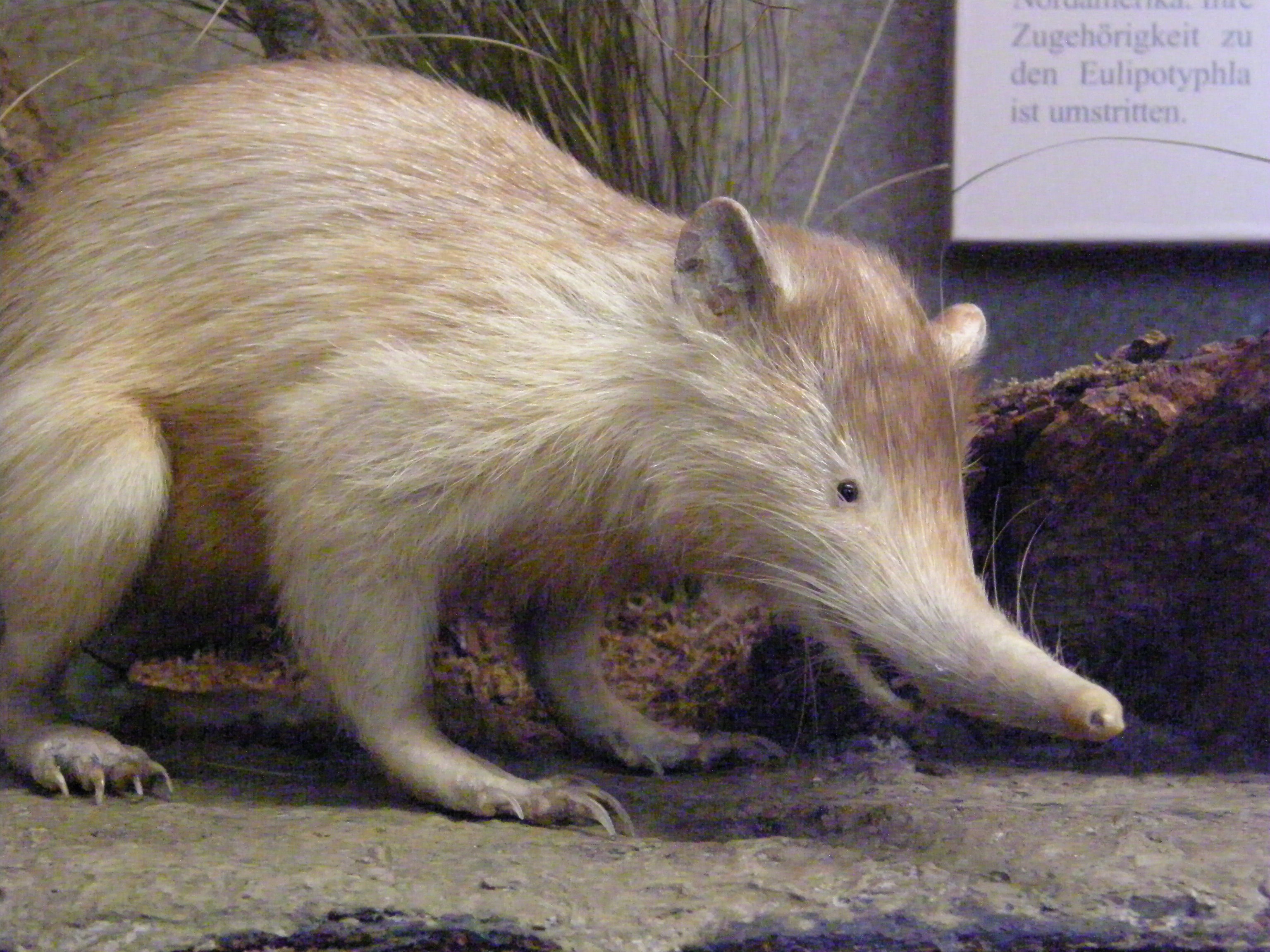
Also known as the Haitian Solenodon or Agouta, is a solenodon only found on the island of Hispaniola, shared by Haiti and the Dominican Republic, and was unknown to science until 1833, when it was first described by Brandt. 
It weighs between 0.6 and 1.0 kg, and is 28 to 33 cm long (the tail measures an extra 25 cm). It has brownish-red fur on most of its body, the underside being a lighter shade. The tail, legs, snout and eartips are hairless. The forelegs are noticeably more developed than the hind ones, but all have strong claws useful for digging. The head is very big in relation to its body, and it has a long rostrum with tiny eyes and ears, partially hidden by the body fur.

5. Bactrian Camel 
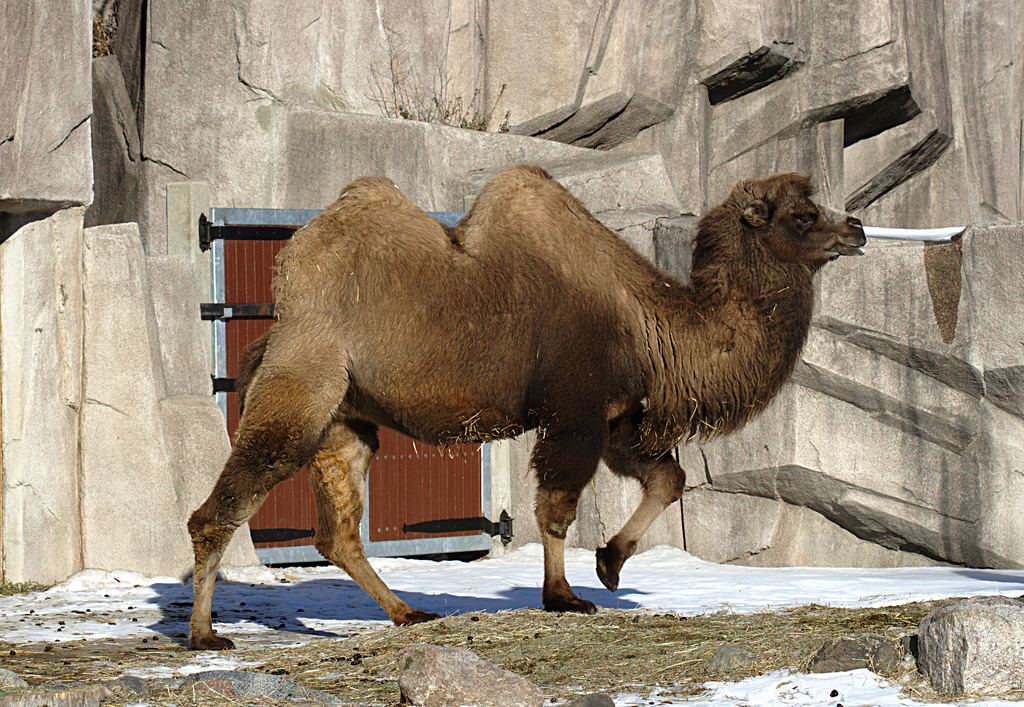
The Bacterian camel (Camelus bactrianus) is a large even-toed ungulate native to the steppesof north eastern Asia. It is one of the two surviving species of camel. The Bactrian Camel has two humps on its back, in contrast to the single-humped Dromedary Camel. Nearly all of the estimated 1.4 million Bactrian Camels alive today are domesticated, but in October 2002 the estimated 950 remaining in the wild in northwest China and Mongolia were placed on the critically endangered species list. 
6.Pygmy Hipopotamus


The pygmy hippopotamus (Choeropsis liberiensis or Hexaprotodon liberiensis) is a large mammal native to the forests and swamps of western Africa (the scientific species classification means "of Liberia", as this is where the vast majority live). The pygmy hippo is reclusive and nocturnal. It is one of only two extant species in the Hippopotamidae family, the other being its much larger cousin the common hippopotamus.
The pygmy hippopotamus displays many terrestrial adaptations, but like its larger cousin, it is semi-aquatic and relies on proximity to water to keep its skin moisturized and its body temperature cool. Behaviors such as mating and giving birth may occur in water or on land. The pygmy hippo is herbivorous, feeding on whatever ferns, broad-leaved plants, grasses and fruits it finds in the forests.


7. Long eared jerboa
The Long-eared Jerboa, Euchoreutes naso, is anocturnal mouse-like rodent with a long tail, long hind legs for jumping, and exceptionally large ears. It is distinct enough that authorities consider it to be the only member of both its genus, Euchoreutes, and subfamily, Euchoreutinae.
It has been reported in China and in ten localities in desert habitats of Trans Altai Govi Desert and the Gobi Desert in Mongolia. A large part of the species is believed to occur in Mongolia within protected areas. Very little is known about the species.

8. Bumblebee bat

Kitti's Hog-nosed Bat(Craseonycteris thonglongyai), also known as the bumblebee bat, is about 29–33 millimetres (1.14–1.30 in) in length and 2 grams (0.07 oz) in mass), hence the common name of "bumblebee bat". It is the smallest species of bat and may be the world's smallest mammal. It is a vulnerable species of bat and the only member of the family Craseonycteridae. It occurs in western Thailand and southeast Burma, where it occupies limestone caves along rivers.
Kitti's Hog-nosed Bat is the smallest species of bat and one of the world's smallest mammals. It has a reddish-brown or grey coat, with a distinctive pig-like snout. Colonies range greatly in size, with an average of 100 individuals per cave. The bat feeds during short activity periods in the evening and dawn, foraging around nearby forest areas for insects. 


9.Golden Rumped Elephant shrew

The Golden-rumped Elephant Shrew (Rhynchocyon chrysopygus) is the largest of the African elephant shrew family. It is the size of a small rabbit, and is only found in the coastal Arabuko Sokoke National Park north of Mombassa in Kenya. 
The Golden-rumped Elephant Shrew lives on the forest floor of evergreen forests, rooting through the leaf litter for 80% of the waking day looking for grasshoppers, beetles, spiders and other small invertebrates.
It is very fast, capable of running at 25km/h. When it detects a predator within its 'flight distance' it will bound off. If, however, the predator is outside its flight distance the elephant shrew will advertise its presence by slapping the leaf litter. As a final precaution each shrew has several nests which it maintains, thus a predator finding a nest will not learn to associate them with potential food.

10. Hirola


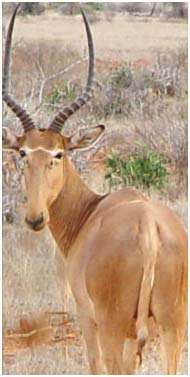
The Hirola (Beatragus hunteri, sometimes Damaliscus hunteri also known as Hunter's Hartebeest) is an antelope species found in arid grassy plains in a pocket on the border between Kenya and Somalia. It's the only member of the genus Beatragus.
Hirola are known as the "four-eyed antelope," due to their large preorbital glands. Hirola stand 100 to 125 centmetres at the shoulder and weigh 80 to 118 kilograms. Their coat is a sandy brown colour, greyer in males than females, with a lighter underbelly and a small white strip over the bridge of the nose. The nape of the neck has very thick skin which forms ridges when the ears are pricked up. The horns are lyre shaped and very conspicuously ringed.


Thursday, October 29, 2009

Formation Of Earth - An Amazing History


The theory which explain the origin of earth and this Universe is called Big Bang Theory. According to this theory all matter in the Universe was, at one time, concentrated in a giant mass (a black hole?) that blew apart about 10 to 20 billion years ago (bya) and is still expanding.

Origin of Sun:
It is thought that our solar system had its origins when, about 5 bya, triggered by some unknown cause, a cloud of interstellar dust and gases collapsed and condensed. Some of the matter in the central mass contracted under its own gravity, condensed, and heated until forces were so strong that thermonuclear reactions began, and this was the origin of our star, the Sun.

Origin of Planets:
About 4.6 to 4.5 billion year ago, a disk-shaped cloud of subsidiary smaller lumps, pieces, dust, gases, etc. orbiting the sun subsequently coalesced and condensed to form theplanets, satellites, asteroids, comets, etc.

Formation Of Atmosphere:
 It is thought that Earth began as a cold world, and the very first atmosphere may have been hydrogen gas, but since that is so light weight and very chemically reactive, most of it would have floated off into space or reacted with other substances, thus would have been rapidly dissipated. Then some other volcanic activities and other chemical reaction took place.The inner four, solid planets have started out with similar atmospheres of H2O, CO2, CO, and N2. These chemicals made up the atmosphere of our planet for the first 1 billion years, and initially, provided similar atmospheres for the other three solid planets.However, the distance of each of these planets from the sun has influenced what subsequently took place there:
  • Mercury is too close to the sun and too hot. Any water that might have been there (and any other volatile chemicals) would, long ago, have evaporated into space.
  • Venus also is too close to the sun to have any surface water. 
  • Mars, on the other hand, is too far away from the sun, and so is too cold. Any water and carbon dioxide present on the planet are frozen solid in the “ice” cap. Also, the planet is too small to hold very much atmosphere, and there is not enough of a greenhouse effect to keep the planet warm. Thus, there is essentially no atmosphere left.
But these conditions happen to be just right here on planet Earth. We are just the right distance from the sun! On Earth, the heat and the size are such that the water is neither all frozen nor all vaporized. Because liquid water is present, this has enabled formation of the lakes and oceans needed for life to evolve.

Formation of Earth Surface:
Over the next 3.5 billion years, the amount of CO2 in our atmosphere was reduced as it became incorporated into rocks (limestone is CaCO3 and forms when H2O + CO2 --> H2CO3and H2CO3 + Ca++ --> CaCO3 + 2H+). The liquid oceans formed about 3.8 billion years ago, and life has been present for nearly as long. Evidence would indicate that on early Earth, there was much more volcanic activity, many more electrical storms, and more violent and destructive meteor impacts. Because of this impact heating (and Earth’s internal heat) the Earth subsequently melted, and heavier molten materials sank to the center, forming the core, while lighter ones floated to surface and formed the crust. Thus Earth now has several layers:
  • A central core composed of very dense metals such as iron and nickle
  • The mantle, which actually consists of several layers of varying composition, and is a molten, medium density, viscous liquid
  • The crust floats on the outside. Because the minerals in the crust are cooler, they have formed strong, rocky layers collectively referred to as the lithosphere.
Origins of Life:
The atmosphere was made largely of water vapor (H2O), carbon dioxide (CO2), carbon monoxide (CO), nitrogen (N2), methane (CH4), and ammonia (NH3). As the surface of Earth cooled again, torrential rains of this mixture formed the first seas, the “primordial soup.”
1. First, organic monomers (simple sugars, amino acids, fatty acids, and nucleotides) would have to be synthesized abiotically from inorganic substances like methane, carbon dioxide, and ammonia. Around all 20 amino acids, and a number of sugars, lipids, and nucleotides have been obtained from these inorganic substances(H2O, H2, CH4 and NH3). 

2. The second step would be the formation of organic polymers and genetic material from the existing monomers (polysaccharides from simple sugars, proteins from amino acids, and RNA from nucleotides), possibly using hot sand or finely divided clay as a catalyst.

3. Thirdly, it is thought that non-living aggregates of these polymers formed. These may have exhibited some properties characteristic of living organisms, but were NOT ALIVE, and did not have all the properties of living organisms. In a research laboratory, scientists have seen mixtures of proteins, lipids, and carbohydrates form globules. If the proteins involved happen to be enzymes, these globules can even carry on "metabolic" activity, although they have no means to replicate themselves. Several widely-accepted theories as to how this may have happened include the possibly involvement of damp, zinc-containing clay as a catalyst to help the nucleotides polymerize first into RNA, and later into DNA.

4. It is thought, then, that about 4.1 to 3.5 billion years ago, the first prokaryotes, like bacteria, came into existance. It is difficult to pinpoint a date for this because bacteria don't have skeletons to leave behind. The first “fossils” (remains of colonies/secretions) of prokaryotes seem to be this age. Once the first cells, the first living organisms, the first prokaryotes came into existance, then the Theory of Evolution takes over to provide an explanation for how (not why) these primitive cells diversified into the five kingdoms of life which we recognize today.
Initially, the energy needed for growth and development was supplied by glycolysis and fermentation. There was no free oxygen in the early atmosphere, and indeed, any organisms living back then would have probably been poisoned/killed by this highly-reactive chemical. Only later, as photosynthetic organisms released increasing amounts of this toxic waste into the atmosphere, did the process of cellular respiration evolve as a means of making use of this oxygen.
Related Posts with Thumbnails